Electrician Insurance · Guide
Electrical work sits in an unusual spot compared to most other trades. Get it wrong and the consequences aren't limited to a cosmetic fix or an awkward conversation with a client, they can escalate into fire damage, serious injury, or worse.
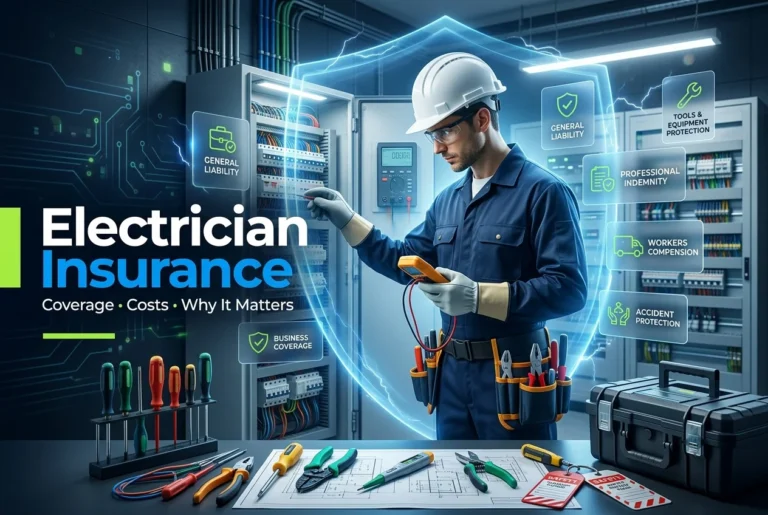
Answer: Electrician insurance is a bundle of covers including public liability, professional indemnity, employers' liability and tools cover that protects against third-party injury, property damage and legal costs. Costs vary by work type and coverage limits, but it is essential because electrical faults can lead to fire, injury and major financial claims.
Electrical work sits in an unusual spot compared to most other trades. Get it wrong and the consequences aren't limited to a cosmetic fix or an awkward conversation with a client, they can escalate into fire damage, serious injury, or worse. That heightened stakes-level is exactly why electrician insurance isn't something to treat as an afterthought once you're already juggling job bookings and van stock. Whether you're newly qualified and working solo or running an established electrical contracting business with a small crew, understanding what cover you actually need, and what it's likely to cost, makes a real difference to how exposed you are when something goes wrong.
This guide walks through the different layers of cover that fall under the electrician insurance umbrella, what drives pricing up or down, and the practical questions worth asking before you commit to a policy.
Insurers don't treat all trades equally, and electricians consistently sit toward the higher end of the risk scale. A loose connection, a miswired circuit, or a rushed job on an old consumer unit can lead to outcomes far more serious than a wonky shelf or a chipped tile. Fire investigators frequently trace domestic and commercial fires back to electrical faults, and when that happens, the financial and legal fallout can be substantial, sometimes involving multiple parties, insurers, and lengthy investigations.
Because of this, electrician insurance isn't really one policy but a collection of covers assembled to match the specific risks of the trade. Public liability sits at the core, but many electricians also carry professional indemnity, tools cover, and employers' liability if they've taken on staff. Understanding how these pieces fit together, rather than assuming a single generic policy covers everything, is the first step toward being properly protected.
Electrician liability insurance, more specifically public liability insurance tailored to electrical work, is usually the starting point for anyone in the trade. It responds when your work causes injury to a third party or damage to property that isn't yours. Picture a scenario where a customer's home suffers water damage because an electrician working on an outdoor socket left a small gap that let rain in, later causing a short circuit. The repair costs, potential displacement of the homeowner, and any resulting dispute could easily run into thousands of pounds without this cover in place.
It's worth being clear about the boundary of what liability insurance actually does. It protects against harm to others, not against your own tools being stolen or your own time lost redoing a job. Those situations are usually addressed through separate policies, tools cover and professional indemnity respectively, which is why so many electricians end up bundling several types of cover together rather than relying on liability insurance alone.
Coverage limits matter here too. Many domestic electricians carry £1 million or £2 million of liability cover, but commercial electrical contractors, particularly those working on larger sites or public buildings, are often contractually required to carry £5 million or more before they're even allowed to start work.
The moment an electrician moves from working entirely alone to hiring even one employee or regularly bringing in subcontractors, the insurance picture shifts. Electrical contractor insurance at this scale typically needs to account for a wider range of exposure: multiple people working across potentially several sites, greater equipment value moving between jobs, and often larger commercial contracts with stricter insurance clauses written directly into the paperwork.
Employers' liability insurance becomes a legal requirement in the UK once you take on staff, with very few exceptions, so this isn't an optional add-on for a growing electrical contracting business, it's a baseline legal obligation. On top of that, many electrical contractors find they need higher liability limits than they did as a sole trader, simply because larger projects carry a correspondingly larger financial risk if something goes wrong.
There's also the question of subcontractors. If your electrical contracting business regularly brings in subcontracted electricians for busier periods, it's worth checking carefully whether your policy extends to their work or whether each subcontractor needs to hold and prove their own separate cover. Gaps here are a common and expensive oversight.
There's no single figure that applies across the board, since electrical contractor insurance cost depends on a combination of factors that insurers weigh individually:
Broadly speaking, many sole trader electricians pay somewhere in the range of a modest annual premium for standard liability cover, while electrical contracting businesses with staff, higher coverage limits, and commercial project exposure can pay considerably more. Getting a handful of quotes with accurate, specific information about your actual scope of work is the most reliable way to find out what applies to your situation rather than relying on rough averages.
Insurance for electricians isn't one-size-fits-all, and the right combination of policies depends heavily on the type of work you take on day to day. A domestic electrician doing rewiring, consumer unit upgrades, and general fault finding faces a different risk profile than someone specialising in commercial fit-outs, industrial maintenance, or renewable energy installations.
Electricians working on gas-adjacent systems, such as those doing combined electrical and heating controls work, sometimes need to think about how their cover interacts with other trades' requirements too. And electricians increasingly installing EV charging points at domestic and commercial properties are entering a growing but still relatively new area of risk assessment for insurers, so it's worth specifically flagging this type of work when getting quotes rather than assuming it falls under general domestic cover.
Tools and equipment cover is another piece worth factoring in. Specialist testing equipment, such as multifunction testers or thermal imaging cameras, represents a significant financial loss if stolen from a van, and many electricians find that bundling this alongside liability cover works out more cost-effective than buying it separately.
It's a common misconception that public liability insurance covers every possible electrical mishap. It doesn't. If a client argues that your electrical design or certification advice was flawed, leading to a financial loss even without any physical injury or property damage, that's a scenario professional indemnity insurance is built for, not liability cover.
This distinction matters more for electricians doing design work, certification, or consultancy alongside hands-on installation, since the risk of a purely financial dispute is higher than for someone doing straightforward reactive repair work. Many electrical contractor insurance packages now bundle professional indemnity alongside liability cover specifically because insurers recognise how often the two risks overlap in practice.
An electrician without a reliable van is effectively an electrician who can't get to the next job, which is why vehicle-related cover, and increasingly vehicle choice itself, factors into the wider insurance conversation. Electric vans are becoming a much more common choice among tradespeople, including electricians who already work closely with EV charging installations and understand the technology well.
If you're weighing up switching your work van to an electric model, it's worth reading up on the practical side of that decision before committing. Our friends at evehicleuk.com cover the realities of running electric vehicles in the UK, which pairs naturally with thinking through your broader business costs alongside your electrician insurance setup.
It helps to zoom out occasionally and see electrician insurance as one example of a much broader principle: spreading the financial risk of unpredictable events across many policyholders so no single person absorbs the full shock alone. That same underlying logic shows up in insurance markets that look nothing like construction or trades on the surface. For an example of how this plays out for pet owners managing unpredictable veterinary bills, resources like petinsusa.com illustrate how premiums, excesses, and coverage limits are structured in a completely different but conceptually related market.
Within the electrical trade specifically, the main policies worth understanding are public liability (third-party injury or property damage), professional indemnity (financial loss from advice or design errors), employers' liability (a legal requirement once you have staff), and tools or equipment cover. Mapping out which of these genuinely apply to your work prevents both dangerous coverage gaps and unnecessary duplication that eats into your margins.
An electrician replacing a consumer unit accidentally causes a short that damages a client's smart home system, worth several thousand pounds in equipment. A commercial electrical contractor's subcontracted team leaves a temporary supply improperly isolated overnight, and a security guard on-site receives a shock while doing rounds. A domestic electrician's certification on a rewiring job is later challenged after a property sale falls through due to a survey flagging non-compliant work. None of these situations are far-fetched, they're the kind of ordinary, unglamorous risk that comes with the trade, and in each case, having the right insurance in place is what separates a difficult week from a genuinely business-ending event.
Timing is also worth understanding properly. Electrical faults sometimes don't surface until well after a job is finished, occasionally months later when a fault develops gradually. Most liability policies allow for a reasonable window to report claims after the fact, which is worth confirming clearly with your insurer rather than assuming cover ends the day you leave the property.
Electrician insurance isn't the most exciting part of running an electrical business, but it's one of the few costs that directly determines whether a single bad incident becomes a manageable setback or a genuinely business-ending event. Given how much higher the stakes are with electrical work compared to many other trades, from fire risk to serious injury, treating proper cover as a baseline cost of doing business rather than an optional extra is one of the more straightforward decisions an electrician can make. Matching your policy to the real risks of your specific work, rather than defaulting to the cheapest generic option, is what actually protects the business you've worked hard to build.
It isn't a blanket legal requirement for every electrician, but employers' liability becomes mandatory once you take on staff, and most competent person scheme registrations expect proof of adequate cover as a condition of membership.
It covers legal costs and compensation if your electrical work causes injury to someone else or damages property that isn't yours, protecting you from expenses that would otherwise come straight out of your own pocket.
It depends heavily on the type of work, coverage limit, and claims history, but many sole trader electricians pay a modest annual premium for liability cover, while larger electrical contracting firms with employees pay considerably more due to broader exposure.
Electricians typically face higher risk pricing than many other trades because faulty electrical work carries the potential for fire and serious injury, so policies are often underwritten with that added exposure specifically in mind.
Public liability generally covers third-party injury or property damage caused by your work, but financial loss purely from substandard workmanship without third-party harm is usually a matter for professional indemnity cover instead.
If you work entirely alone with no employees or casual staff, it typically isn't required, but the moment you take on even one worker, employers' liability insurance becomes a legal requirement in most circumstances.
Yes, registration with a recognised competent person scheme can sometimes lead to more favourable pricing, since it signals a lower likelihood of costly errors to insurance underwriters.


Your trusted UK partner for EV charger installation, electric vehicle conversion, and fleet solutions.