Electric Vehicles · Insurance Guide
Picture two renewal letters arriving on the same doormat three years apart, both for the same make and model of family car, one running on petrol, the other on a battery. The gap between them has narrowed further than most drivers realise.
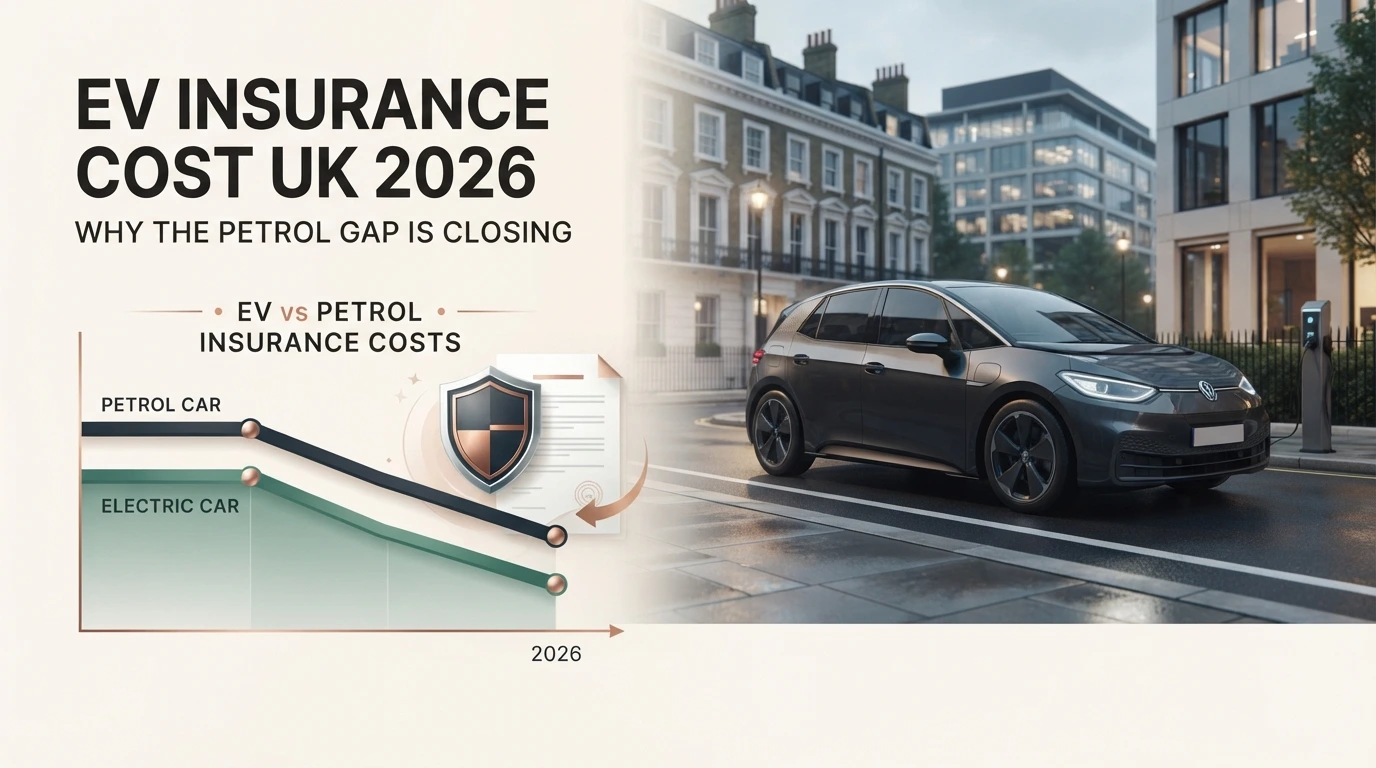
Answer: Electric car insurance in the UK is still slightly pricier than petrol cover on average, but the gap has narrowed from roughly 20–30% a couple of years ago to around 10–15% for typical family-sized EVs in 2026, with small city EVs now landing close to petrol pricing outright. Premium and performance electric models still carry a wider gap, driven by higher vehicle values and costlier components.
Picture two renewal letters arriving on the same doormat three years apart, both for the same make and model of family car, one running on petrol, the other on a battery. In 2023, the electric letter would have carried a noticeably bigger number, often uncomfortably so. Pull the equivalent letters today and the gap between them has narrowed enough that a lot of drivers wouldn't think twice about which one belonged to which car. That's the story of UK electric vehicle cover this year, told through numbers rather than sentiment.
None of this happened because an insurer decided to be generous. Four separate forces in the market moved at roughly the same time, and together they've dragged electric car insurance a long way toward parity with its petrol counterpart. Anyone who wrote off going electric a couple of years ago purely because of a scary quote is looking at a genuinely different landscape now, and it's worth walking through exactly what shifted rather than taking that on faith.
Averages are slippery things, so a single side-by-side example tends to land better than a percentage on its own. Take a popular mid-size hatchback sold in both fuel types. Two or three years back, a typical driver might have paid something like £650 annually to cover the petrol version, against £800 to £850 for the identical car built around a battery instead of a tank. That difference, well over a hundred pounds, was large enough to cancel out a good chunk of what drivers were saving at the charger compared to the pump.
Ask for the same two quotes today and the electric figure has drifted down toward £700 to £730, close enough to its petrol twin that the difference barely registers against everything else that shapes a premium. Smaller, city-oriented electric cars have gone even further, with some models now costing almost identically to insure regardless of what powers them. The remaining daylight between petrol and electric hasn't disappeared everywhere, but for the bulk of ordinary family motoring, it's stopped being a meaningful factor in the decision to switch.
Every insurance premium is really a bet, and bets get sharper the more an insurer knows about the thing they're betting on. For the first wave of mass-market EVs, that knowledge simply didn't exist yet in the UK, so insurers padded their pricing to cover the uncertainty rather than the actual risk. Years of genuine claims history later, that padding has largely come off, because the numbers being priced against are now real rather than estimated. This single change probably explains more of the recent movement than any other factor on this list.
There was a stretch when getting a battery-powered car fixed after a fender bender meant joining a queue for one of a scarce number of garages qualified to touch a high-voltage system. That scarcity did two expensive things at once: it stretched out repair times, and it nudged insurers toward scrapping cars that a properly equipped workshop would have simply patched up. A wave of investment in training and equipment across both independent garages and main dealers has thinned that queue considerably, and every car that gets fixed instead of written off pulls the average claim cost down a little further.
Not long ago, only a handful of household-name insurers bothered building a proper EV product, which left the segment with far less pricing pressure than the petrol market has always had. That's changed. A much wider field is now chasing electric vehicle business specifically, and a crowded field behaves the way crowded fields always do: providers sharpen their pencils rather than pad their margins, especially for the handful of models everyone's fighting over.
A wrecked battery pack has always been the single scariest number behind a total-loss claim. As manufacturing at scale has brought unit costs down, and as newer battery designs have leaned toward modular construction that's easier to repair rather than replace wholesale, the worst-case figure an insurer has to plan for has shrunk too. It's the slowest-moving of the four factors, but it's still pulling in the same direction as the other three.
A single national figure hides more than it reveals, so it helps to think by vehicle type instead.
Layered on top of whichever category your car falls into, the same familiar variables still apply exactly as they would for a petrol vehicle: how long you've held a licence, how many miles you cover a year, where you live, your claims record, and whether the car does double duty for work as well as personal trips.
None of the figures above will match your specific car, postcode, or driving pattern exactly, which is exactly why it's worth running your own details rather than anchoring to a general estimate. You can look at model-specific pricing trends and how they apply to particular EVs on UK roads through the tools available here, which go beyond national averages into the kind of detail that actually affects your own quote.
A handful of ideas about EV insurance took root in the early years of the market and never quite got updated. Worth revisiting each one now.
"Every electric car costs roughly the same to insure." This was almost true when insurers had so little to go on that most models got lumped into a similar cautious bracket. That era is over. The distance between a small city EV and a high-end performance model is now wide enough that treating "electric" as one single pricing category will mislead you badly. What matters is the specific model and trim in front of you.
"Battery size barely moves the needle on price." It moves the needle more than almost anything else. A bigger, costlier pack to replace generally means a bigger premium, holding everything else constant, even as the underlying cost of batteries keeps falling industry-wide.
"There's no point shopping around for an EV policy." Given how much fresh competition has entered this specific corner of the market, this is precisely the wrong year to hold that view. A short annual comparison is more likely than ever to turn up genuine savings, because there are simply more insurers now fighting for the same customer than there were even two years ago.
"An older EV will always be cheaper to cover than a brand-new one." Not reliably. A model that predates the recent improvements in repair networks and claims data can end up quoted higher than expected, particularly if parts for a discontinued line have become harder to source. Age alone is a weak predictor; the actual quote is the only thing worth trusting.
For most mainstream cars, yes, though only by a modest margin now, and every indicator points toward that margin continuing to shrink rather than reverse. Anyone weighing up a compact or city-sized EV is looking at a difference small enough that it probably shouldn't tip the decision either way. Anyone eyeing a premium or high-performance model should expect a more durable gap, since that one is tied to genuinely higher vehicle values and pricier components rather than anything a more experienced insurance market can fully smooth away.
The real change here isn't really about the number on the page, it's about what that number represents. A few years back, a higher EV premium was simply the toll you paid for going electric, a fixed cost nobody expected to challenge. This year, it's turned into just another line item worth negotiating, the same way petrol cover always has been, because real savings are now sitting there for anyone willing to compare.
That habit of comparing rather than assuming applies well beyond the car park. Pet owners are navigating a strikingly similar renewal-shock story with their own premiums, and Pet Ins USA walks through the same comparison-first thinking for that market. Households keeping half an eye on broader financial trends alongside their insurance renewals might also find Oman Gold Rate Today's blog and Qatar Gold Rate Today useful, both tracking daily precious metal pricing for readers managing household finances across the Gulf region.
Usually, yes, though the difference has shrunk to somewhere around 10 to 15 percent for typical models in 2026, down from a much wider 20 to 30 percent gap a couple of years earlier. Small city EVs have closed the distance almost entirely, while premium and performance models still carry a more noticeable difference.
It depends heavily on the specific car, your postcode, and your own driving history, but a typical family-sized EV now often costs close to its petrol equivalent plus a fairly modest premium, while smaller electric cars can land very close to petrol pricing outright. A quote built around your actual details will always beat any national figure.
Four things moving together: insurers finally have enough genuine claims history to price with confidence instead of caution, far more garages are equipped to repair high-voltage systems, a wider field of insurers is competing hard for EV customers, and battery replacement costs have kept easing as manufacturing has scaled up.
Some providers knock a modest amount off for a verified home charging setup, on the logic that it reflects lower reliance on public infrastructure and therefore lower risk. It isn't standard across every insurer, so it's worth raising directly when you're getting quotes.
Generally, yes. Vans and other light commercial EVs are still catching up to their diesel and petrol counterparts, largely because there's a thinner body of claims data behind this category compared with ordinary passenger cars.
For smaller, everyday models, it's already close to gone in a lot of cases. For premium and high-performance electric cars, expect the difference to stick around longer, since it's rooted in genuinely higher vehicle and component values that a more experienced market can narrow but is unlikely to erase entirely.


Your trusted UK partner for EV charger installation, electric vehicle conversion, and fleet solutions.